
Table of Contents
Background
GCart DCNT has, for all intents and purposes, only 2 active components. First the actuall memory which is a 128k SRAM. Then a programmable logic/analog circuit from GreenPAK. These are one of my absolute favorites. I have been using them for a decade now, but on every new assignment I come (as a electronic consultant) they are news.
Anyway.
What is it?
GreenPAK is a series of programmable logic/analog chips. They are OTP — One Time Programmable — so the design needs to be free of bugs. They have a large selection of building blocks, such as gates, delay lines, counters, I2C/SPI, edge detectors, and flip-flops. They also feature multiple oscillators with pre/post-scalers and multiple outputs. Some variants include pattern generators, operational amplifiers/comparators, LDOs, H-bridges for motor control, rheostats, and state machines.
And it works with 5V which suits us "retro tinkers" very well.
In GCart DCNT there is a SLG46533V which is a mid-range of the available types.
What does it do in GCart DCNT?
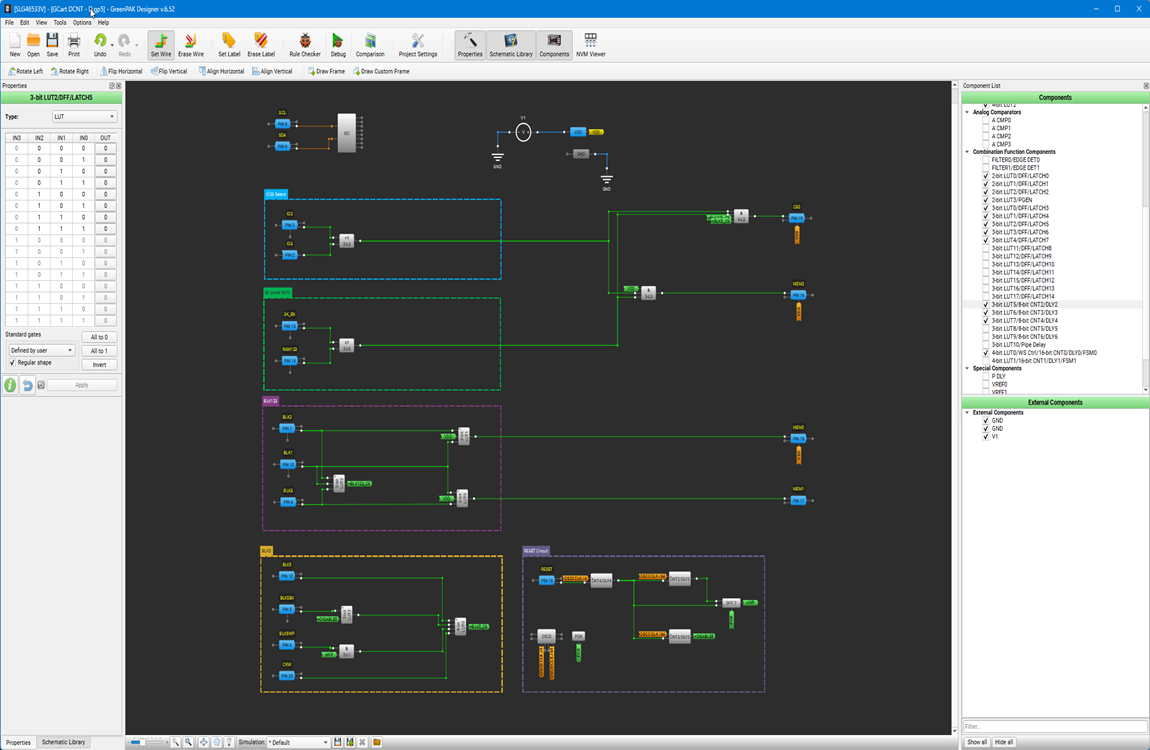
- Decodes BLK1,2,3 and 5 with IO2 and 3 as well as RAM1,2 and3 into CS for the SRAM.
- Decodes BLK1,2,3 and 5 with IO2 and 3 as well as RAM1,2 and3 into 3 bits A13-A15. Each block is 8k and IO2, 3 and RAM1, 2 and 3 occupies one 8k block.
- Manages BLK5 write protection, by gating the BLK5 to CS.
- Deglitches and Monitors the RESET signal for short press (<0.5s), long press (0.5s to 1s) or an extended (>1s) press. These in turn enables temporary write protection and temporary disable BLK5.
- LED driver. It also drives the RESET buttons red LED to indicate when BLK5 is write protected or is temporarily disabled.
Implementation
The decoding is pretty straight forward and not much to write home about. If you have not heard about GreenPAK, then perhaps the reset monitoring can be interesting though.
RESET Circuit
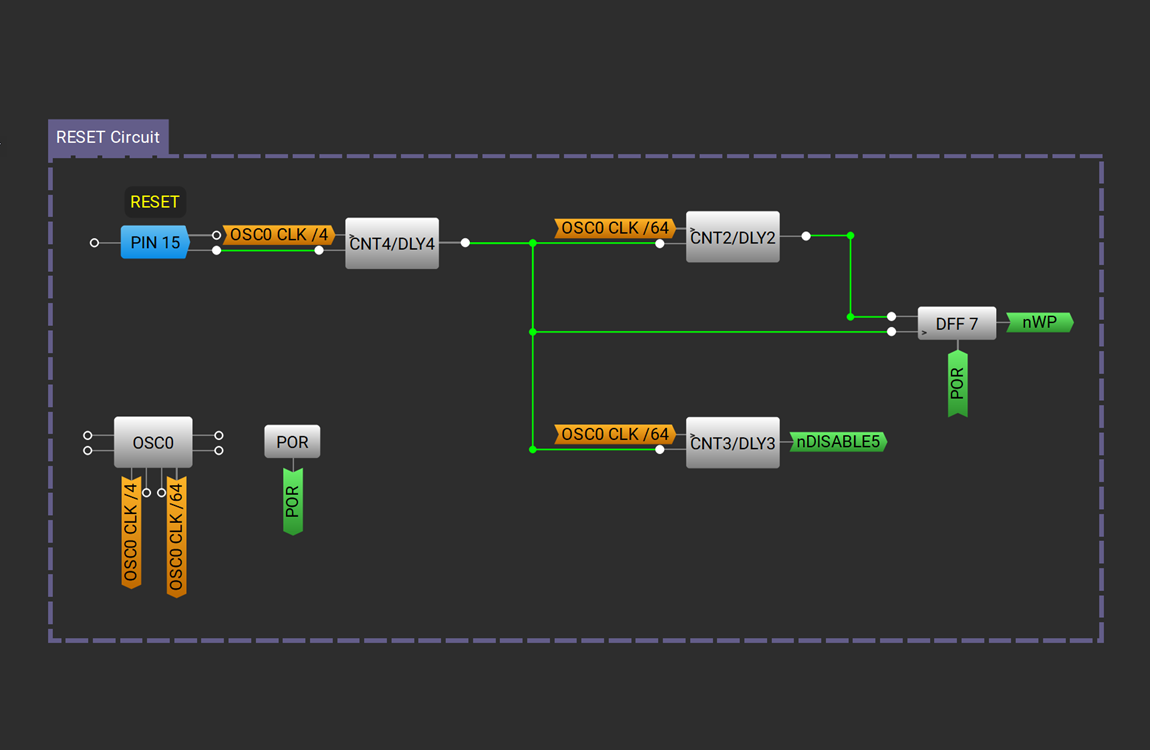
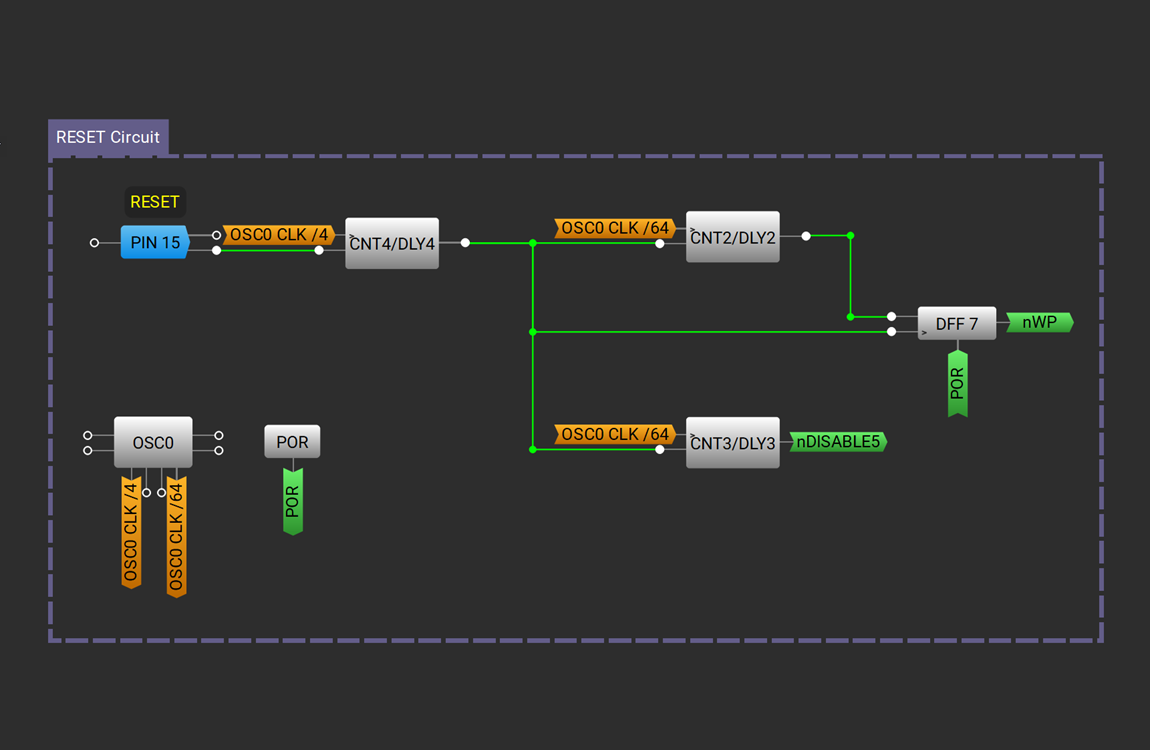
The POR is a Power on Reset. It is driven low during start-up and makes sure the Flip-Flop DFF7 is at a reset state at power on.
OSC0 is the oscillator for the delay lines. It is configured as a 25kHz RC oscillator. It has 2 outputs. One divided by 4 and one divided by 64.
CNT4/DLY4 is configured as a delay of ~50ms. It is triggered on both rising and faling edges. Any change on the input needs to be stable for ~50ms to follow through. This is a deglitch filter. After that we have very clean reset signals, no matter where they come from on the VIC20.
This deglitched RESET is feed into two additional delay blocks CNT2/DLY2 and CNT3/DLY3. They are also triggered on both rising and faling edges. The CNT2/DLY2 has a delay of 500ms and the CNT3/DLY3 has 1s.
That means a long press will follow through on CNT2/DLY2 after 500ms and CNT3/DLY3 after 1s.
When RESET is released, it's rising edge will lock the CNT2/DLY2 value in DFF7. This in turn will write protect, or not, BLK5. Regardless of what the DIP switch is set to.
If the reset was a extended press, then nDISABLE5 is activated. This temporarily disables BLK5. After another second after RESET goes high, CBT3/DLY3 also goes high and BLK5 is enabled again. But during that time the Kernal has missed any cartridge image in BLK5 and skipped it, exiting to BASIC.
For a short press neither CNT2/DLY3 nor CNR3/DLY3 will engage.