
Table of Contents
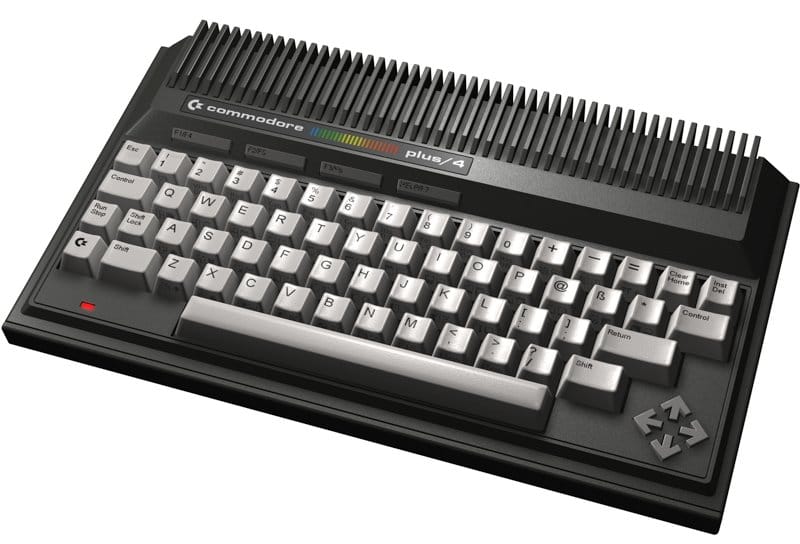
The Plus/4 and C16 never got the love the C64 did. Commodore's 264 series, built around the TED chip, arrived in 1984 and was more or less gone again a couple of years later. Which is exactly why I find it interesting.
Recently I went to the yearly Swedish Commodore meeting, and got to spend some time with a Plus/4. That was enough. When I got home I bought a mint condition unit from Italy, and now it is time for hardware.
Same thinking as with my VIC 20 projects. Every project has a specific idea or test in mind, and the same ground rules apply: no drilling in the case, every change reversible, and no wires hanging out through the case.
FATTED
FATTED is to the Plus/4 what FATVIC is to the VIC 20. A drop-in replacement for the TED chip (7360/8360), implemented in an FPGA.
TED does a lot more than video. It handles video, sound, timers, the keyboard latch, DRAM refresh and clock generation. All of that has to work exactly as before, otherwise it is not a drop-in replacement. The extras come on top, and they are always optional.
The big one is sprites. TED never had them, and that is probably the one thing people point at when comparing it to the C64. So FATTED adds them.
- 32 sprites, plus tiles.
- Sprite and tile data accessed through one or two indirect data pointers with auto-increment. Set the address once, then just keep writing.
- 4 direct sprite attribute windows. Select a sprite, then access X, Y, flip and index directly. They are kept together as one block starting at $FDE0.
- Possibly a SID sound generator inside the chip as well, owning the $FDE0 to $FEBF area.
Why $FDE0? That area has been unused on the Plus/4 since day one, sitting just below where the 1551 drives map in. And with the cartridge below taking care of drives, I don't expect anyone to ever add more.
Video output is the same puzzle as on FATVIC. The chip swap itself is the easy part. Getting a better picture out of the machine without touching the case is where the work is.
TEDDY
The Plus/4 disk drive was the 1551. Instead of the slow serial bus, it connected via a paddle in the expansion port and talked over a parallel bus called TCBM. Much faster, but the 1551 is rare today and the paddle occupies the expansion port.
Modern alternatives exist, like the Pi1551 with a TCBM paddle. They work very well, but it is a stack of boards, cables and a Raspberry Pi next to the computer. I wanted all of it in one cartridge.
So this cartridge is three things at once. A flash multicart, a cycle-exact 1551 and a Meatloaf.
- 256 cartridge images in built-in NOR flash.
- Device 8 is a cycle-exact 1551 emulation, running disk images from SD card or NOR flash. Cycle-exact, so fast loaders work.
- Device 9 is a Meatloaf style network drive over TCBM, with WiFi. It also gives the machine network time.
- A SPI EEPROM for configuration and game storage, like high scores.
Most UI is going to be through a management application. But there is a LCD display for quick overview.
The manager lives in the cartridge itself, in the C1LO bank, and is active at reset. Hold a key combination during reset to start the manager, the file browser or one of your predefined shortcuts. Otherwise it just gets out of the way.